
With over 35 years of experience organising walking holidays in France, Walks in France handles all the logistics so you can focus on the trail. Your accommodation is booked in quality hotels and guesthouses, your luggage is transferred from stage to stage, and you receive a detailed route book with maps and directions. You set your own pace, carrying nothing but a daypack.
Your complete guide to walking in Alsace
Walking in Alsace is a journey through one of Europe's oldest wine-producing regions. The Alsace Wine Route, or Route des Vins d'Alsace, stretches 170 kilometres from Marlenheim in the north to Thann in the south. Our walking holiday covers the most scenic central section, from the medieval walled town of Turckheim to the charming market town of Obernai. Along the way, you pass through villages that look as though they belong in a book of fairy tales: half-timbered houses painted in bright colours, cobbled streets lined with flower boxes, and church steeples topped with the white stork nests that are one of Alsace's most beloved symbols.
The route follows well-marked trails through the foothills of the Vosges Mountains, alternating between vineyard paths, forest tracks and ridgeline walks with views stretching across the Rhine plain to Germany's Black Forest. Daily stages range from 12 to 20 kilometres, with some ascents of 400 to 700 metres when the trail climbs to castle ruins and mountain passes. The walking is moderate to moderately challenging, suitable for anyone with good fitness who enjoys varied terrain.
Key stages of your Alsace walking holiday
Turckheim and the Hohlandsbourg
Your walk begins in Turckheim, a fortified village on the Alsace Wine Route famous for its night watchman who still makes his rounds through the cobbled streets each evening in summer. On your first walking day, you climb through chestnut forests to the imposing Château du Hohlandsbourg, a medieval fortress that dominates the entrance to the Munster Valley. From the ramparts, you have panoramic views over Colmar, the vineyards and the Rhine plain. The trail then loops back down through the vines to Turckheim.
Through the vineyards to Kaysersberg and Riquewihr
Leaving Turckheim, the route crosses some of the finest vineyard landscapes in Alsace. You pass through the tiny village of Niedermorschwihr, notable for its twisted church spire, before reaching Kaysersberg. This village, birthplace of Albert Schweitzer and regularly voted among the favourite villages of the French, has a ruined imperial castle and a fortified bridge spanning the Weiss river. From Kaysersberg, you continue through the vines to Riquewihr, one of the most visited villages on the Wine Route. Its perfectly preserved medieval streets, enclosed within 16th-century ramparts, have earned it the "Plus Beaux Villages de France" designation.
Ribeauvillé, the Three Castles and Haut-Koenigsbourg
The trail from Riquewihr leads you to Ribeauvillé, another medieval wine town overlooked by three castle ruins perched on the same ridge: Saint-Ulrich, Girsberg and Haut-Ribeaupierre. You climb through forest to reach these atmospheric ruins, where the views over the town and the plain are exceptional. In the days that follow, you continue north past the village of Saint-Hippolyte to the spectacular Château du Haut-Koenigsbourg. Restored in the early 20th century on the orders of Kaiser Wilhelm II, this imposing fortress sits at 757 metres and offers a complete picture of medieval castle life.
Mont Sainte-Odile and Obernai
The final section of your Alsace walking holiday takes you to Mont Sainte-Odile, one of the most important pilgrimage sites in the region. This mountaintop monastery, dedicated to the patron saint of Alsace, sits on a rocky promontory high above the plain. The panoramic views from the terrace extend as far as Strasbourg on a clear day, and the mysterious Pagan Wall, a megalithic enclosure that encircles the summit plateau, remains an archaeological enigma. From Mont Sainte-Odile, you descend through forest to the attractive market town of Obernai, where your walk ends.
Landscapes of Alsace
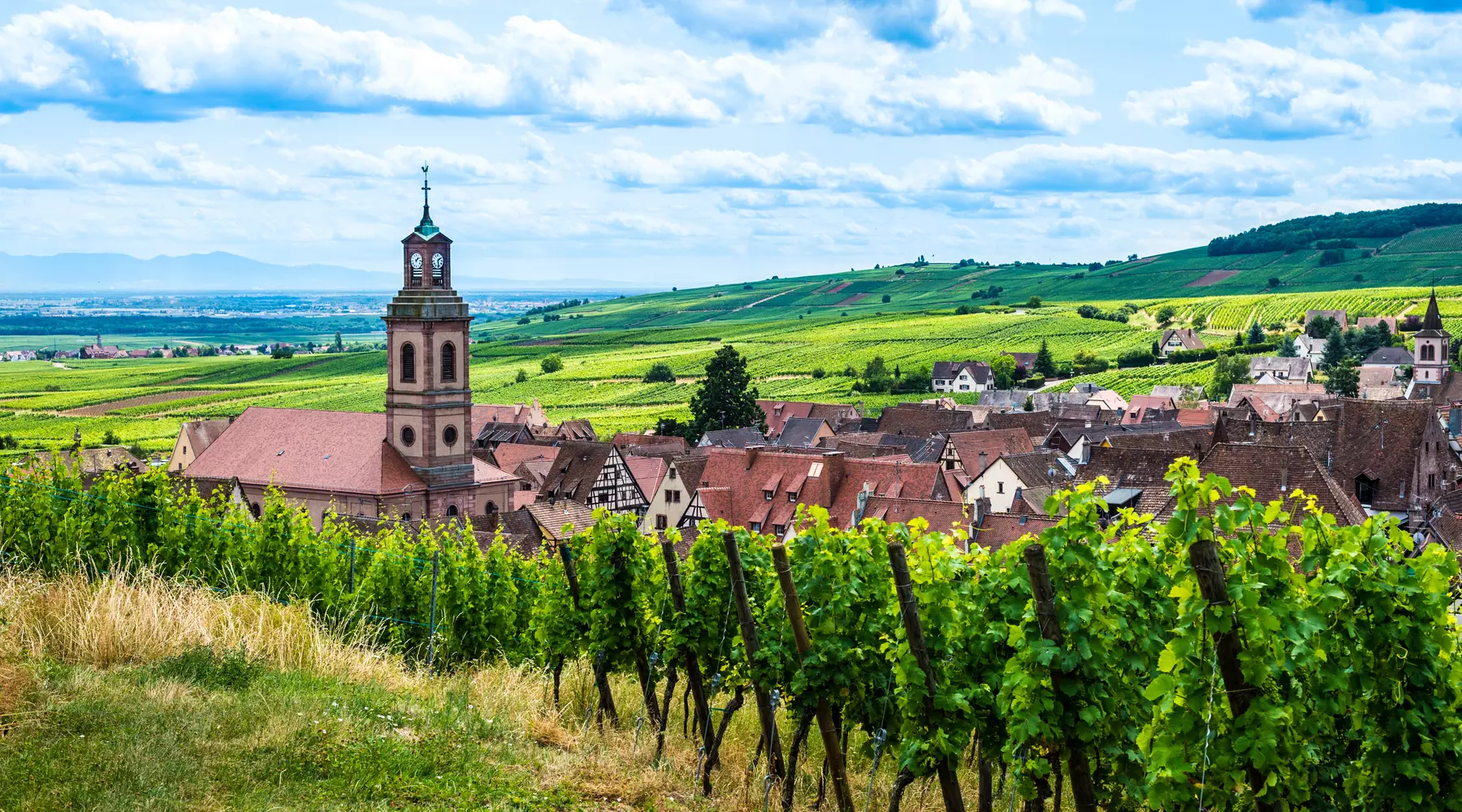
The Alsace Wine Route and vineyards
The vineyards of Alsace are draped across the eastern slopes of the Vosges, facing the morning sun and sheltered from Atlantic rain by the mountains. Walking through them in late summer and autumn, when the vines are heavy with grapes, is a remarkable experience. The soil changes from one hillside to the next, and so does the grape variety: Riesling, Gewürztraminer, Pinot Gris, Muscat, Sylvaner and Pinot Noir all thrive here. Many of the vineyards are classified as Grands Crus, and you will pass signs marking these prestigious terroirs throughout your walk.
The Vosges Mountains and forests
When the trail climbs away from the vineyards, you enter the dense forests of the Vosges. These are mountains of moderate height, with rounded summits known as ballons, but the walking is varied and rewarding. Oak, beech and chestnut forests give way to pine at higher altitudes, and the silence is broken only by birdsong. Scattered across the ridges are the ruins of more than 500 medieval castles, a concentration found nowhere else in Europe. Many of these ruins are accessible from the walking trails, and their dramatic silhouettes against the sky are a constant feature of the Alsatian landscape.
The Rhine Plain
From the higher points on your walk, the views extend east across the Rhine plain to the Black Forest in Germany. This flat, fertile lowland stretches between the Vosges foothills and the Rhine river, and its patchwork of fields, orchards and scattered villages provides a striking contrast to the vertical landscapes of the vineyard slopes and mountain forests above.
Castles of Alsace
No walking holiday in Alsace is complete without exploring the region's remarkable concentration of medieval castles. The Vosges ridges are dotted with more than 500 castle ruins, and many of them are directly on or near the walking trails. Three fortresses stand out along your route.
Château du Haut-Koenigsbourg
The Haut-Koenigsbourg is the most visited castle in Alsace. Perched at 757 metres on a rocky spur above the village of Saint-Hippolyte, it was extensively restored between 1901 and 1908 and gives a vivid impression of life in a medieval mountain fortress. The views from the ramparts stretch across the Rhine plain to the Black Forest, and on clear days you can see as far as the Alps.
The Three Castles of Ribeauvillé
Above the town of Ribeauvillé, three ruined castles occupy the same wooded ridge: Saint-Ulrich, Girsberg and Haut-Ribeaupierre. The largest, Saint-Ulrich, dates from the 11th century and retains impressive walls, a chapel and a great hall with Romanesque windows. The climb through the forest to reach these ruins is one of the most rewarding walks on the entire itinerary.
Château du Hohlandsbourg
The Hohlandsbourg overlooks the Munster Valley and the town of Colmar from an altitude of 620 metres. Built in 1279, it has been restored in recent years and now houses exhibitions on medieval life and warfare. You reach it on your first walking day out of Turckheim, and the panoramic views from the walls are an unforgettable introduction to the Alsatian landscape.
Medieval villages of Alsace
Eguisheim
Eguisheim is considered the birthplace of Alsatian winemaking. This village, voted France's favourite village in 2013, is arranged in concentric circles around a central castle square. Its half-timbered houses, painted in shades of yellow, pink and blue, are among the most photographed in the region. You can visit Eguisheim as a short detour from Turckheim at the start of your walk.
Riquewihr
Riquewihr is often described as the pearl of the Alsace vineyards. Enclosed within its 16th-century ramparts, the village has changed remarkably little over the centuries. The main street, lined with oriel windows and carved wooden signs, leads to the Dolder, a fortified gate tower dating from 1291. Wine cellars and tasting rooms are found on almost every corner, and the village is renowned for its Riesling production.
Kaysersberg
Kaysersberg, whose name means "Emperor's Mountain", guards the entrance to the Weiss Valley. Its ruined castle, fortified bridge and colourful market square make it one of the most complete medieval ensembles in Alsace. The village is also the birthplace of Albert Schweitzer, and a small museum dedicated to the Nobel Peace Prize winner occupies his family home near the church.
Why choose Walks in France for your Alsace walking holiday
We have been organising self-guided walking holidays in France since 1988. Our team knows the Alsace trails, accommodation and local communities from first-hand experience. When you book an Alsace walking holiday with us, you benefit from our knowledge and personal attention.
Your holiday includes half-board accommodation in carefully selected hotels along the route. We organise your luggage transfer between each stage so you walk with just a light daypack. You receive a comprehensive route book with detailed descriptions, maps and practical information. And if you need to adjust the itinerary, whether shorter stages, extra rest days, or a different starting point, we can create a tailor-made walking holiday to suit your requirements.
If you enjoy walking through historic regions of France, you may also be interested in our Dordogne walking holidays through the Périgord Noir, our Stevenson Trail walking holidays on the GR70, or our Mont-Saint-Michel walking holidays. For those drawn to pilgrimage routes, our St James Way and Camino de Santiago walking holidays offer a wide range of itineraries across France and Spain.
Practical tips for walking in Alsace
The best months for an Alsace walking holiday are May, June, September and October. Late spring brings wildflowers and fresh green vineyards, while autumn offers harvest colours, grape-picking season and the first new wines. Summer (July and August) is warm and pleasant for walking, though some days can be hot. December is a special time in Alsace, when the famous Christmas markets fill every village square, though walking itineraries are not typically available during this period.
The nearest airports are Strasbourg, Basel-Mulhouse and Karlsruhe-Baden-Baden. Strasbourg is well connected by TGV from Paris (1 hour 45 minutes) and by regional trains to towns along the Wine Route, including Obernai, Barr and Colmar. From the United Kingdom, you can reach Strasbourg by Eurostar via Paris or by direct flights from several airports.
The walking terrain in Alsace is varied. Vineyard paths and village lanes are generally easy, but the ascents to castle ruins and mountain ridges can be steep, with daily elevation gains of 400 to 700 metres on the more demanding stages. Good walking boots with ankle support are essential, along with a waterproof jacket (showers can develop quickly in the Vosges), sun protection and a water bottle of at least 1.5 litres.
Alsatian gastronomy is among the richest in France and draws on both French and Germanic traditions. Look out for flammekueche (a thin-crust tart topped with crème fraîche, onions and lardons), choucroute garnie (sauerkraut with assorted meats), baeckeoffe (a slow-cooked casserole of potatoes, meat and wine), and kougelhopf (a brioche-like cake). The wine, of course, is exceptional: Alsace is the only region in France where wines are labelled by grape variety rather than by appellation, and tastings are offered in cellars and winstubs throughout your walk.
Request your free quote for an Alsace walking holiday and let us help you plan your next walking adventure in France.
Frequently asked questions about Alsace walking holidays
How difficult is walking in Alsace?
Walking in Alsace is graded moderate to moderately challenging (level 2 to 3). The vineyard paths and village sections are easy, but the trail climbs regularly to castle ruins and Vosges ridges, with daily elevation gains of up to 700 metres on the more demanding days. Anyone with good general fitness who walks regularly will enjoy this itinerary.
What is the Alsace Wine Route?
The Alsace Wine Route (Route des Vins d'Alsace) is one of the oldest wine routes in France, established in 1953. It runs 170 kilometres from Marlenheim to Thann along the eastern foothills of the Vosges Mountains, passing through more than 70 wine-producing villages. Walking the Alsace Wine Route is one of the best ways to experience it, as the trail passes directly through the vineyards and villages rather than following the road. Our Alsace Wine Route walking holiday covers the most scenic central section, from Turckheim to Obernai, where the concentration of classified villages and Grands Crus vineyards is at its highest.
What is included in a self-guided Alsace walking holiday?
Your holiday includes half-board accommodation (dinner, bed and breakfast) in quality hotels, luggage transfer between each stage, a detailed route book with maps and walking directions (one per room), and local tourist tax. Transport to the start point and from the finish, midday meals, drinks, castle entrance fees and personal expenses are not included. We can arrange transfers from the nearest railway stations on request.
Can I customise my Alsace walking holiday?
Yes. If the standard itinerary does not suit your schedule or fitness level, we can adapt it. You can add rest days to explore Colmar or Strasbourg, shorten stages, choose different accommodation, or combine your Alsace walk with another region. Simply send us your requirements and we will prepare a tailor-made proposal.
When is the best time to walk in Alsace?
The best periods are late spring (May to June) and autumn (September to October). Spring offers mild temperatures, wildflowers and lush green vineyards. Autumn brings grape harvest season, golden colours, and the chance to taste the first new wines of the year. Summer is also suitable but can be hot on exposed vineyard slopes.
Which Alsace villages should I not miss?
The walking route passes through many of Alsace's most celebrated villages. Riquewihr, Kaysersberg and Eguisheim all hold the "Plus Beaux Villages de France" label. Ribeauvillé is famous for its three castle ruins and medieval festival, while Obernai and Turckheim are charming walled towns with excellent restaurants and wine cellars.
Is Alsace suitable for wine lovers who walk?
Alsace is one of the best destinations in France for combining walking and wine. The trail passes directly through vineyards and wine-producing villages, and many cellars offer tastings to walkers. You can sample Riesling, Gewürztraminer, Pinot Gris and other varieties throughout your holiday, often directly from the producer.