
From Le Puy en Velay to Nasbinals
The Way of Saint James de Compostela from Le Puy en Velay to Nasbinals.

Nasbinals - Conques
The Way of St. James de Compostela from Nasbinals to Conques.

Le Puy en Velay - Conques
The Way of Saint James de Compostela from Le Puy en Velay to Conques.

From Conques to Cahors
The Way of Saint James de Compostela from Conques to Cahors

From Cahors to Lectoure.
The Way of Saint James de Compostela from Cahors to Lectoure.

From Lectoure to Aire sur l'Adour
The Way of Saint James de Compostela from Lectoure to Aire su l'Adour.

From Aire sur l'Adour to Saint Jean Pied de Port.
The Way of Saint James de Compostela from Aire sur l'Adour to Saint Jean Pied de Port.

From Figeac to Cahors by the Célé.
The Way of Saint James de Compostela from Figeac to Cahors by the Célé.

From Figeac to Cahors by Rocamadour.
The Way of Saint James de Compostela from Figeac to Cahors by Rocamadour.
Our agency, Walks in France, is based in Saugues, a village on the Way of St James just two stages after Le Puy-en-Velay. We have been organising self-guided walking holidays on this trail since 1988 and were among the very first to offer luggage transfer, accommodation booking and route guidance to pilgrims and walkers on the Le Puy Camino. Our self-guided GR65 walking holidays let you complete the route in sections at your own pace, returning each year to continue where you left off. With over 35 years of experience, we know every stage, every village and every accommodation option on this route personally.
Your complete guide to the Le Puy Camino
The Le Puy Camino, or Way of St James in France, follows the GR65 long-distance trail from Le Puy-en-Velay to Saint-Jean-Pied-de-Port. The full route takes approximately 30 to 35 walking days to complete, but you do not need to walk it all at once. Many walkers choose to complete it in sections over several holidays, returning each year to continue where they left off. We offer self-guided walking holidays covering every section of the trail, so you can walk from Le Puy to Conques, from Conques to Cahors, from Cahors to Aire-sur-l'Adour, or any other combination that suits your schedule.
The Camino de Santiago in France is a very different experience from the Spanish Camino Francés. The trail passes through some of the least populated and most beautiful regions of south-west France. Villages are smaller, the landscape is wilder, and you are more likely to find yourself walking alone through open countryside than in a crowd of fellow pilgrims. The accommodation is typically in small family-run hotels and guesthouses rather than large pilgrim hostels, and the regional gastronomy along the way is exceptional.
See all the stages of the Chemin du Puy
Key stages of the Way of St James in France
Le Puy-en-Velay to Conques
The first major section of the trail covers approximately 200 kilometres from Le Puy-en-Velay to Conques. You begin in one of the most striking small cities in France: Le Puy-en-Velay is built around volcanic pinnacles, and its Romanesque cathedral, the statue of Notre-Dame de France and the chapel of Saint-Michel d'Aiguilhe are all UNESCO World Heritage Sites. From Le Puy, the trail climbs into the Velay mountains, crosses the wild Margeride plateau, and passes through Saugues, where our agency is based and where the legend of the Beast of Gévaudan still lingers. You then cross the vast Aubrac plateau, a landscape of open grassland, granite farms and herds of Aubrac cattle, before descending through the Lot Valley to Conques. The medieval village of Conques, with its Romanesque abbey church of Sainte-Foy and its famous tympanum depicting the Last Judgement, is one of the great highlights of the entire pilgrimage.
Conques to Cahors
From Conques, the trail descends into the Lot Valley and passes through a succession of villages classified among the Most Beautiful Villages of France: Saint-Côme-d'Olt, Estaing and Espalion. This section is gentler than the first, with rolling hills, vineyard terraces and the meandering course of the Lot river as your companions. You reach Figeac, birthplace of Champollion, before arriving in Cahors, a city famous for its fortified Valentré Bridge (another UNESCO site) and its dark Malbec wines.
Cahors to Aire-sur-l'Adour
Beyond Cahors, the landscape changes again. The trail crosses the rolling farmlands of the Tarn-et-Garonne and enters Gascony, a land of sunflower fields, gentle hills and Armagnac vineyards. You pass through Moissac, whose Romanesque cloister at the Abbey of Saint-Pierre is one of the finest in Europe, and then through the fortified bastide town of Lectoure. This is a quieter section of the trail, where the walking is less strenuous and the pace of life slows to match the unhurried Gascon countryside.
Aire-sur-l'Adour to Saint-Jean-Pied-de-Port
The final section of the Way of St James in France takes you from the plains of the Landes into the foothills of the Pyrenees. The trail passes through Navarrenx, one of the oldest fortified towns in the Béarn region, before three of the four historic French pilgrimage routes converge near Ostabat. From there, the trail descends to Saint-Jean-Pied-de-Port, the traditional gateway to Spain and the starting point of the Camino Francés. This charming Basque village, with its cobbled streets and pink sandstone houses, is the place where pilgrims have gathered for centuries before crossing the Pyrenees to continue their journey to Santiago de Compostela.
Landscapes of the French Way of St James
The Massif Central: Velay, Margeride and Aubrac
The opening stages of the trail cross some of the most dramatic landscapes in central France. The Velay mountains around Le Puy are volcanic, with basalt plateaux and deep gorges carved by the Allier river. The Margeride is a high, forested plateau dotted with granite villages, while the Aubrac is a vast open grassland at over 1,000 metres altitude, exposed to wind and weather but hauntingly beautiful. Walking across the Aubrac in spring, when the pastures are bright with wildflowers, is one of the defining experiences of the pilgrimage.
The Lot Valley and Quercy
After the high plateaux, the descent into the Lot Valley brings a dramatic change of scenery. The landscape becomes warmer, more intimate, with limestone cliffs, walnut groves and villages of golden stone perched above the river. This section shares some similarities with the neighbouring Dordogne walking holidays we offer, and walkers who enjoy the Lot Valley often choose to explore the Périgord as well.
Gascony and the Pyrenean foothills
The final third of the trail crosses the gentle, rolling countryside of Gascony before the Pyrenees appear on the southern horizon. Sunflower fields, maize plantations and small market towns characterise this section, and the food becomes distinctly south-western: foie gras, duck confit, Armagnac and Jurançon wine. As you approach the mountains, the landscape rises and the Basque influence begins to appear in the architecture and the place names.
All You Need to Know About the Camino de Santiago
UNESCO World Heritage highlights along the route
The Way of St James in France passes through an exceptional concentration of UNESCO World Heritage Sites, reflecting a thousand years of pilgrimage history. Four monuments along the GR65 are inscribed on the World Heritage list as part of the Routes of Santiago de Compostela in France, and they are among the most memorable stops on the trail.
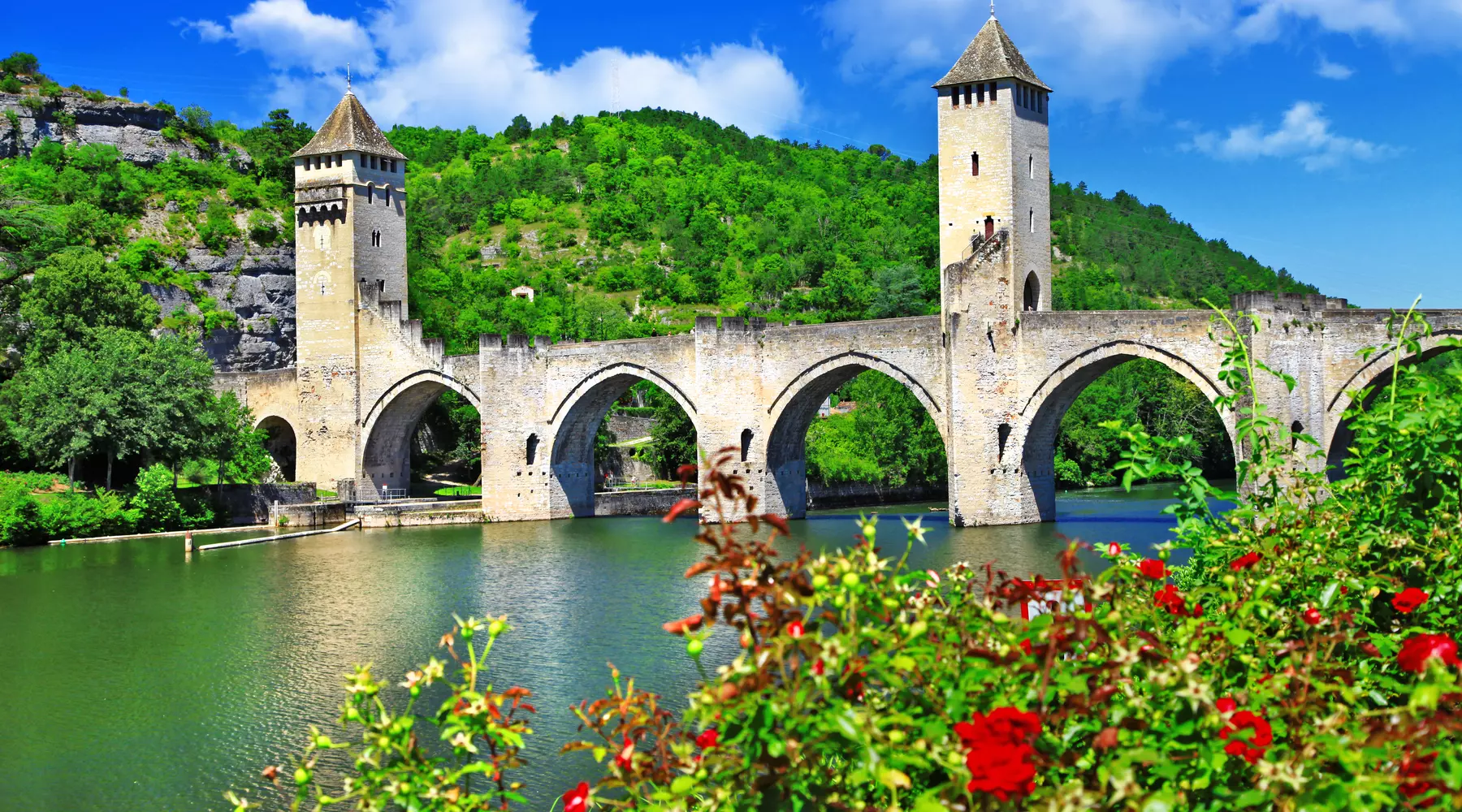
In Le Puy-en-Velay, the Romanesque cathedral of Notre-Dame and the adjoining Hôtel-Dieu form part of the inscription, alongside the extraordinary chapel of Saint-Michel d'Aiguilhe perched on its volcanic needle. In Conques, the abbey church of Sainte-Foy is one of the masterpieces of Romanesque architecture, famous for its sculptured tympanum and its treasury of medieval goldwork. In Cahors, the fortified Valentré Bridge, with its three towers reflected in the Lot river, has become one of the most recognised images of the pilgrimage. And in Moissac, the cloister of the Abbey of Saint-Pierre, with its 76 carved marble capitals, is considered one of the finest Romanesque cloisters in existence. Walking the Le Puy Camino, you encounter these treasures not as a tourist visiting isolated sites, but as a pilgrim discovering them in sequence, each one marking a stage of your journey.
Why choose Walks in France for the Way of St James
We are specialists in the Way of St James. Our agency was founded on this trail, and organising walking holidays on the Camino de Santiago in France has been our core activity for over 35 years. We are based in Saugues, on the GR65 itself, which means we have first-hand knowledge of every stage, every accommodation and every local community along the route.
Your holiday includes half-board accommodation in carefully selected hotels and guesthouses along the trail. We organise your luggage transfer between each stage so you can walk with just a light daypack. You receive a detailed route book with stage descriptions, maps and practical information. And because the Way of St James is a long trail, we offer complete flexibility: you can walk one section this year and return next year to continue, you can shorten or lengthen stages, add rest days, or create a completely tailor-made walking holiday based on your available time and fitness level.
If you plan to continue your pilgrimage beyond France, we also organise walking holidays on the Camino Francés in Spain, as well as the Camino del Norte and the Camino Portuguese. For an overview of all our Camino routes, visit our St James Way and Camino de Santiago page.
Practical tips for walking the Way of St James in France
The best months to walk the Le Puy Camino are May, June, September and early October. Spring offers wildflowers on the Aubrac and pleasant temperatures, while autumn brings golden light, quieter trails and grape harvest season in the Lot and Gascony. July and August are possible but can be very hot in the lower sections, and accommodation on the most popular stages fills up quickly in summer.
Le Puy-en-Velay is accessible by train from Lyon (2 hours 30 minutes) or from Paris via Lyon or Saint-Étienne. Saint-Jean-Pied-de-Port, the end point of the French trail, is connected by regional train to Bayonne and from there to Paris by TGV. From the United Kingdom, the easiest route is Eurostar to Paris and onward connections by train.
The walking is varied in difficulty. The early stages through the Massif Central are moderately challenging, with significant daily ascents and descents and some exposed sections on the Aubrac. The middle sections through the Lot and Gascony are gentler, while the final approach to Saint-Jean-Pied-de-Port involves some Pyrenean foothills. Good walking boots, a waterproof jacket, sun protection and a water bottle of at least 1.5 litres are essential. We recommend carrying a pilgrim passport (credencial), which you can have stamped at each stage and which serves as a lifelong memento of your journey.
Before you set off, take time to explore Le Puy-en-Velay. Visit the cathedral, climb the 268 steps to the chapel of Saint-Michel d'Aiguilhe, and walk up to the statue of Notre-Dame de France for panoramic views over the city and the surrounding volcanic landscape. The Stevenson Trail (GR70) also begins in Le Puy-en-Velay, and some walkers choose to combine sections of both trails.
Request your free quote for a Way of St James walking holiday in France and let us help you plan your pilgrimage.
Frequently asked questions about the Way of St James in France
How long does it take to walk the Way of St James in France?
The full GR65 from Le Puy-en-Velay to Saint-Jean-Pied-de-Port covers approximately 740 kilometres and takes 30 to 35 walking days to complete. However, many walkers choose to walk it in sections over several years. We offer walking holidays covering every section, from 5-day itineraries to the full trail.
How difficult is the Le Puy Camino?
The Le Puy Camino is graded moderate to challenging (level 2 to 3), particularly in the early stages through the Massif Central. The Aubrac plateau involves exposed walking at over 1,000 metres altitude, and some daily stages exceed 25 kilometres with significant elevation changes. The middle and later sections are gentler. The trail is well marked with the red and white blazes of the GR network throughout.
What is the difference between the French Way and the Spanish Camino?
The Way of St James in France (Le Puy Camino, GR65) runs from Le Puy-en-Velay to Saint-Jean-Pied-de-Port. The Camino Francés begins at Saint-Jean-Pied-de-Port and continues 780 kilometres across Spain to Santiago de Compostela. The French trail passes through wilder, less populated landscapes with smaller villages, while the Spanish Camino has more infrastructure and more fellow pilgrims. Many walkers complete the French section first and then continue into Spain.
What is included in a self-guided Way of St James walking holiday?
Your holiday includes half-board accommodation (dinner, bed and breakfast) in quality hotels and guesthouses, luggage transfer between each stage, a detailed route book with maps and walking directions (one per room), and local tourist tax. Transport to the start point and from the finish, midday meals, drinks and personal expenses are not included. We can arrange transfers from the nearest railway stations on request.
Can I walk the Way of St James in sections?
Yes, and this is how most walkers approach it. The most popular sections are Le Puy to Conques (approximately 10 days), Conques to Cahors (8 days), and Cahors to Saint-Jean-Pied-de-Port (15 days). You can walk one section each year and return to continue where you left off. We keep your details on file so that continuing your pilgrimage is straightforward.
Do I need a pilgrim passport (credencial)?
A credencial is not required but is strongly recommended. You can obtain one in Le Puy-en-Velay before you set off and have it stamped at each stage along the route. If you plan to continue into Spain and walk the final 100 kilometres to Santiago de Compostela, you will need a credencial with stamps to receive the Compostela certificate at the pilgrim office in Santiago.
What makes Walks in France different from other operators?
We are based in Saugues, on the GR65 itself, and have been organising walking holidays on the Way of St James since 1988. We were one of the first agencies to offer luggage transfer and accommodation booking on this trail. Our team walks the route regularly and has personal relationships with the accommodation providers along the way. We offer genuine flexibility, with tailor-made itineraries adapted to your pace, your schedule and your budget.
How many stages are there on the Le Puy Camino?
The GR65 from Le Puy-en-Velay to Saint-Jean-Pied-de-Port is traditionally divided into approximately 30 to 33 stages, with daily distances ranging from 18 to 30 kilometres. However, the number of stages depends on your walking pace and how you choose to break up the route. We can adapt the itinerary to create shorter or longer stages to match your fitness level and preferences, so the number of walking days on your holiday is entirely flexible.