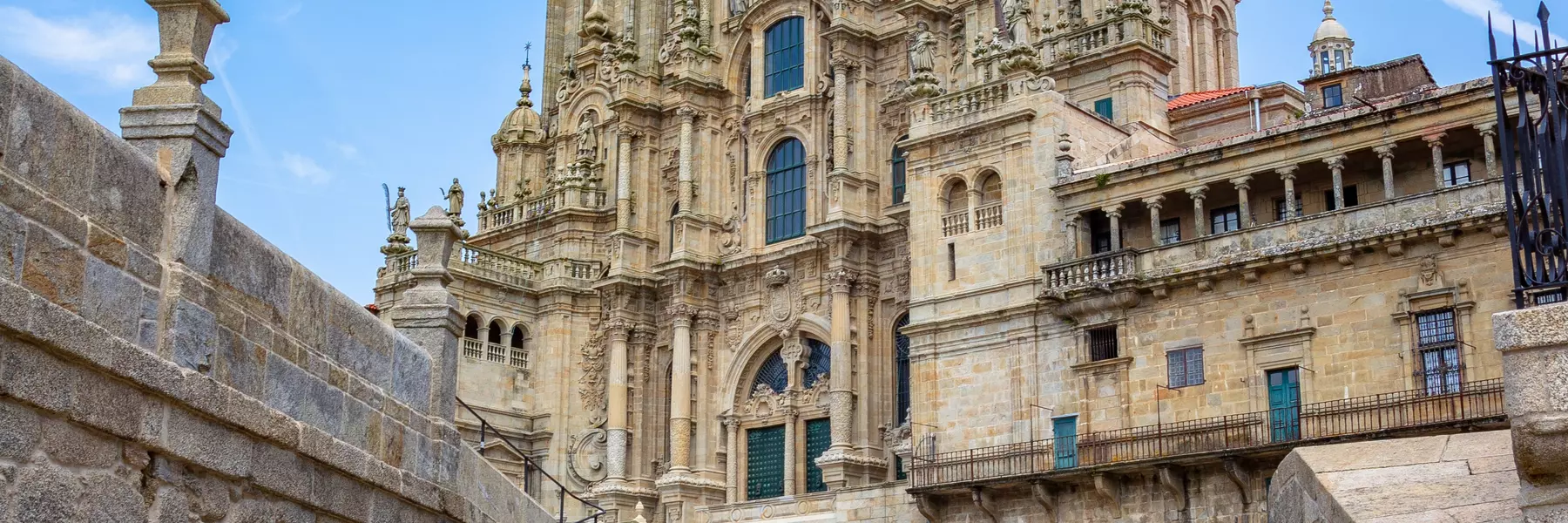
The history of Santiago de Compostela
The story of the Camino de Santiago, step by step
Who was St James? Why has the pilgrimage to the Cathedral of Santiago de Compostela drawn so many people for so long? Here is the story behind one of the world's best-known long-distance walks.
Who was St James?
St James is also known as James, son of Zebedee, James the Great, and Santiago in Spanish. In Christian tradition, he was one of the twelve apostles and one of the closest disciples of Jesus. He is said to have been among the few witnesses of the Transfiguration.
A powerful legend grew up around him. According to tradition, he was sent to the west, including Spain, to spread the Christian faith.
How did the pilgrimage begin?
According to tradition, after Pentecost, St James travelled to Spain to preach. He landed on the Mediterranean coast of Andalusia and made his way to Galicia, in the far north-west of the Iberian Peninsula. After several years, he returned to Jerusalem, where he was beheaded, becoming one of the first Christian martyrs.
Two of his disciples placed his body in a boat and set sail. The boat drifted to the coast of Galicia, running aground in an estuary near the town that would later become Padrón (the second-to-last stage on the Camino Portugués before Santiago). His disciples buried the apostle's body inland, on the site where the city of Santiago de Compostela would be built.